





Super things you should be doing



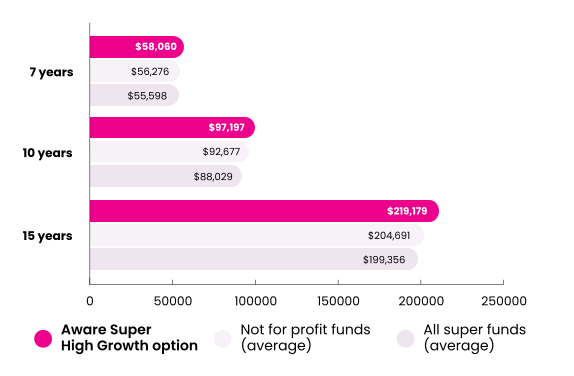
This graph assumes the following; a $50,000 starting account balance; employer contributions based on a starting salary of $50,000 p.a.; salary increases of 3.5% p.a. and contributions tax of 15%. The Net Benefit refers to a member's investment earnings over the time period of 15 years to 31 March 2026, less any administration, investment and member fees for options within the SuperRatings Growth Index (77-90% growth allocation). The net benefit compares Aware Super to the median of 53, 48 and 42 Not for Profit funds over 7, 10 and 15 years and 156, 109 and 58 all super funds over 7, 10 and 15 years which is inclusive of Retail, Industry, Corporate and Government funds. Net Benefit provided by SuperRatings’ Net Benefit Tool, accessed 18th May 2026.’ Past performance is not a reliable indicator or a guarantee of future performance. Outcomes vary between individual funds. View net benefit methodology
FAQs: Super in your 40s
Salary sacrifice for your super is a simple way to boost your retirement savings while paying less tax.[S2] Instead of getting paid and then making a personal contribution, the money goes straight to your super before it’s taxed. Because super contributions are taxed at 15%, and your regular income might be taxed at 32.5% or more, you effectively save money on tax.
Example: Let’s say you earn enough to be in the 32.5% tax bracket and decide to salary sacrifice $100 per pay.
Without salary sacrifice you'd pay $32.50 in tax on that $100.
With salary sacrifice, you only pay $15 in super tax.
That’s a tax saving of $17.50 each time.
Your take-home pay goes down by less than $100, but your super grows faster thanks to compound interest over time.
Just remember to stay within the annual contribution limits; your payroll team can help you set it all up.[S1]
This example is for illustrative purposes only. It relies on various assumptions. If actual circumstances differ from these assumptions, actual results will be different
According to ASFA, around $168,000 at 40 puts you on track for a comfortable retirement. But don't stress if you're not there yet, many aren’t, but there are ways you can bridge the gap and grow your super in your 40s.3
Preparing, and understanding your super, is key to approaching a comfortable retirement. Our My Retirement Planner™ calculator estimates how much money you’ll need in retirement and how much income you are likely to receive in the future, so you can prepare and see where you’re currently at. [AD1]
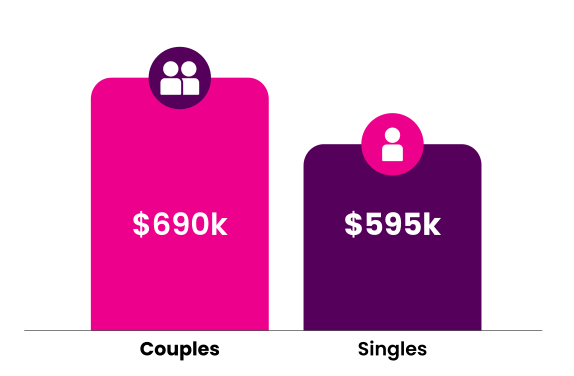
For a comfortable retirement, according to ASFA, you'll want around $595,000 as a single person or $690,000 as a couple.3 This covers things like:
Travel and holidays
Health insurance and medical costs
Home improvements and maintenance
Dining out and entertainment
A decent car and tech gadgets
It’s important to note, these figures assume you own your home outright with no mortgage.
If you or your partner has a lower balance, which can happen with career breaks and wage differences, you can help each other grow super through a few different strategies. You can split up to 85% of your concessional contributions with your spouse or partner, and make after-tax contributions to their account to boost their super balance. This can help you have more money overall when you both retire.[S1] Learn more about the contribution rate and rebates for eligible spouse contributions here.
As your super savings aren’t automatically covered in your Will, nominating a beneficiary ensures that your superannuation is paid to the person or people you choose when you pass away.
Without a valid nomination, your super may not be distributed according to your wishes and could lead to delays or disputes, left to the discretion of your fund’s trustee. A binding nomination gives you the most certainty, as it legally obliges the fund to follow your instructions if the nomination is valid at the time of your death.
Aware Super is one of the biggest funds that allows you to nominate your beneficiary online, without the hassle of multiple forms and paperwork. Simply login to Member Online to nominate today.
If you're serious about optimising your retirement savings, professional advice is important. An adviser can help with tax strategies, investment choices, and catch-up plans tailored to your situation and earning capacity.
At Aware Super, we offer members a Super Helpful Check-in with our in-house super experts at no extra cost, so you can get all your superannuation questions answered.[AD2] You can also book a comprehensive appointment to discuss all aspects of your finances (including insurance) with one of our in-house financial advisors for a fee, which can be paid out of your super if you choose (subject to conditions).[AD1] [AD3]
It’s important to remember that you’ve got 20+ years until retirement, which means you can ride out market ups and downs for bigger long-term gains. Your savings also need to continue to grow after you stop working. Around 30% of the income paid from your super during retirement comes from investment earnings that happen after you retire (you can learn more about this here).
Most people in their 40s opt to focus on growth options rather than conservative investments. The potential returns over the next two decades make short-term volatility worth it.
Talk to one of our in-house financial advisors for expert advice on all things super.[AD1] [AD2]
This depends on your situation. You can make an appointment to speak to one of our experts if you want advice on your specific circumstances.[AD3] [AD1]
1 Investment Trends and Russell Investments research, Australian Financial Advice Landscape 2025 report
2 Source: Super Consumers Australia 2025
3 Source: ASFA 2025
[A3] Awards and ratings are only one factor to be taken into account when choosing a super fund. Past performance is not an indication of future performance.
[AD2] Members can get advice about their Aware Super accounts at no extra cost, or advice on their broader needs for a fee.
[AD3] Fees are payable for comprehensive advice, including about your financial situation outside super. If you decide to move forward with comprehensive financial planning, we’ll explain our fees before you begin.
[F6] Chant West Super Fund Fee Survey 30 June 2026, High Growth [81-95% in growth assets] investment option index and $25,000, $50,000 and $250,000 account balances. Fees and costs can vary from year to year. Past fees and costs are not a reliable indicator of future fees and costs. Fees and comparisons may differ for other investment options and account balances. Aware Super’s High Growth option as published in the Aware Super Future Saver PDS. Zenith CW Pty Ltd ABN 20 639 121 403, AFSL 226872/AFS Rep No. 1280401. Third-party data does not contain all information required to evaluate the nominated service providers. To the extent that any Information provided is advice, it is limited to General Advice only and has been prepared without considering the objectives or financial situation of any individual, including target markets where applicable. It is not a recommendation to purchase, sell or hold any product and is subject to change at any time without notice. Individuals should seek independent advice and consider the PDS or offer document before making any investment decisions. Data is provided in good faith and is believed to be accurate, however, no representation, warranty or undertaking is provided in relation to the accuracy or completeness of the data. Data is subject to copyright and may not be reproduced, modified or distributed without the consent of the copyright owner. Except for any liability which cannot be excluded, Chant West does not accept any liability whether direct or indirect, arising from use of the data. Past performance is not an indication of future performance. Refer to www.chantwest.com.au for full details on Chant West’s research methodology, processes and FSG: https://www.chantwest.com.au/financial-services-guide
[P1] Aware Super's High Growth option return over 10 years to 30 June 2026. SuperRatings Fund Crediting Rate Survey, June 2026. Based on the SR Growth (77-90) Index. Returns are after tax and investment management expenses but before the deduction of administration fees. Past performance is not an indicator of future performance.
[S1] Before contributing, consider the current annual contribution limits. Exceeding these limits may reduce any tax benefits you could receive. Visit Grow your super for more information.
[S2] Salary sacrifice will save tax in many but not all circumstances and will cause a reduction in your take home pay.
[S3] Check your eligibility for the government's super co-contribution before acting on this information.